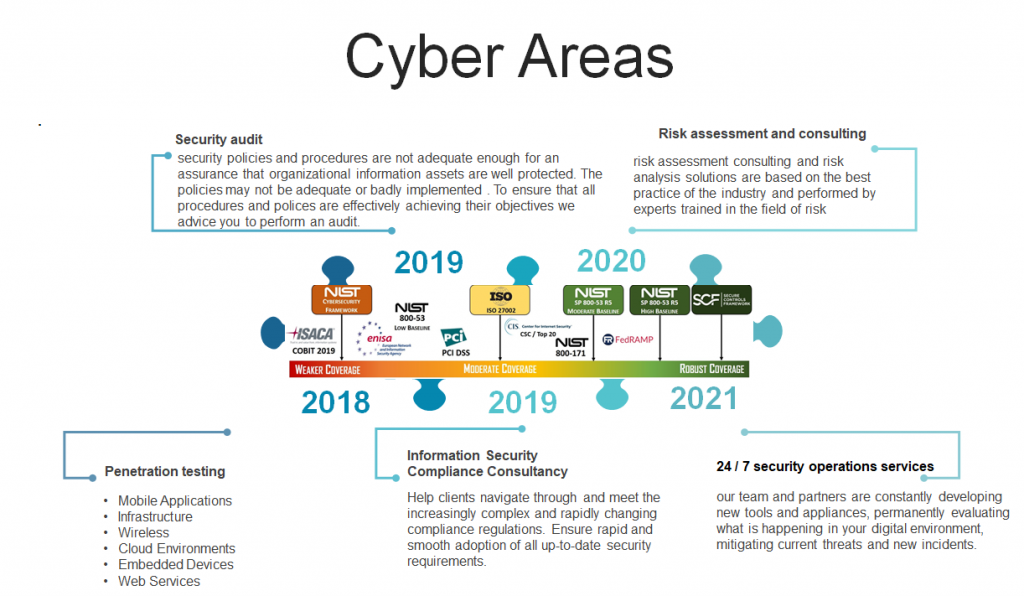
The main questions arise regardless of whether you work for a small business, an established company, or a government department. Executives consistently inquire about cybersecurity, seeking answers to the following key concerns:
1. Are we compliant?
2. Are we secure?
3. What should we do in the event of a breach or attack?
4. What standards do we need to meet or surpass? Have we met them, and will we continue to do so?
5. What measures do we have in place to guarantee ongoing compliance?
Essentially, they are inquiring about the essence of effective cybersecurity practices.
The initial step in developing a cybersecurity roadmap is comprehending your organization’s current state and envisioning its future state. To achieve this, you must define the attributes of your cybersecurity approach and its specific enabling functions.
Security should be proactive, not reactive.
In many organizations, IT and security teams primarily adopt a reactive approach. They have limited capacity for forward planning and are consistently responding to urgent requests like, “It’s 5 PM on a Friday, but this project needs to go live in a few hours. Can you please approve it?” An effective cybersecurity roadmap circumvents such last-minute demands by proactively identifying upgrades and changes. This enables IT and security teams to dedicate more time to strategic activities that aid in detecting and mitigating potential threats, instead of constantly fighting fires.
Security should be unobtrusive.
Cybersecurity teams exist to support the overall operations of the organization and enable the achievement of business objectives in a secure manner. However, well-balanced and organized security measures can sometimes create hurdles, especially if they impede employees in carrying out their tasks. Conversely, no one appreciates an IT team that rejects every request put forward. Striking a balance between preventing bad ideas and allowing organizations to deliver is challenging but essential, requiring the identification of key objectives.
Security processes should be repeatable and documented.
Whatever steps an organization takes to enhance cybersecurity, they must be repeatable—address the problem once and move forward. This approach enables IT teams to focus on high-value work rather than repeatedly fixing the same issue. Equally important is the documentation of crucial processes, ensuring that knowledge is captured and easily reused.
A risk management mindset is crucial.
Effective security relies on a thorough understanding of risks and threats, including how they will be addressed and avoided. Every organization can benefit from a solid grasp of the cybersecurity landscape, both internally and externally, to make informed decisions that align with business objectives.
Within our cybersecurity roadmap, we can delineate four key functions, although their specific operations may vary depending on the organization’s maturity and structure:
- Risk and Compliance: An effective risk and compliance or governance function assists the organization in identifying what needs protection and determining the best approach. This involves identifying assets, understanding risks, selecting controls, establishing metrics, and implementing appropriate policies.
- Security Administration: This function handles essential tasks such as user management (additions and deletions), access management, and conducting reviews.
- Security Architecture and Design: Close collaboration with the business is crucial for this function, as it aims to understand business requirements, identify necessary products, and manage their impacts. Essentially, it determines what needs protection and how to ensure robust protection. Early engagement with the business is key to success in this area.
- Security Operations: This function is responsible for detecting, identifying, and responding to incoming workloads. Its primary objectives are achieving network, server, and endpoint visibility, as well as ensuring that all tools effectively serve their intended purpose.